

How to Write Gothic Product Descriptions That Sell
TL;DR:
- Effective gothic product descriptions balance atmospheric storytelling with clear, practical details to inspire buyer trust. Structuring content with a compelling hook, benefit-driven paragraph, and concise specifications enhances conversion while maintaining mood. Using specific sensory language and natural SEO integration attracts both niche interest and search visibility without sacrificing authenticity.
Your product is extraordinary. The listing? It reads like a shipping invoice. If you’re an independent gothic creator, you already know how to write gothic product descriptions is one of the hardest skills to master. You’re trying to conjure shadow and silk into words while also telling a buyer the size, the material, and when it ships. Most creators end up either too poetic to be useful or too clinical to be interesting. This guide breaks down exactly how to find that balance, using gothic storytelling, practical ecommerce structure, and vocabulary that actually moves product off your virtual shelves.
Table of Contents
- Key takeaways
- How to write gothic product descriptions that connect
- Structuring your description for clarity and atmosphere
- Choosing gothic language that does real work
- Optimizing descriptions for ecommerce and search
- Common mistakes gothic creators make in product copy
- My perspective on gothic copy that actually works
- Explore gothic pieces worth describing
- FAQ
Key takeaways
| Point | Details |
|---|---|
| Know your gothic buyer first | Understand what emotional triggers and aesthetics drive your audience before writing a single word. |
| Use a hybrid description structure | Open with an evocative gothic hook, follow with benefit-driven copy, then list specs in bullet points. |
| Choose language with precision | Specific adjectives like “velvety” and “haunting” build more brand trust than generic terms like “high-quality.” |
| Weave in SEO naturally | Place 2-3 long-tail gothic keywords in your first 100 words without forcing or repeating them unnaturally. |
| Avoid the most common pitfall | Never sacrifice product clarity for atmosphere. Both are required for gothic copy that actually converts. |
How to write gothic product descriptions that connect
Before you type a single word, you need to know who you’re writing for. Gothic buyers are not a monolith. Some are drawn to Victorian mourning aesthetics. Others live in the space between witchcraft and streetwear. Some want high drama and dark romance; others want understated, wearable darkness they can bring into everyday life. Writing for “goths” in general is like painting with one shade of black when the palette holds fifty.
Start by getting specific about your customer. Think about:
- What imagery they respond to. Moonlight and decay? Occult symbols and ritual objects? Victorian tragedy? Each of these signals a distinct aesthetic tribe with different buying values.
- What emotional state they’re shopping from. Gothic buyers often shop to express identity, mark rituals, or add meaning to their environment. They’re not just buying a necklace. They’re buying a piece of who they are.
- What questions make them hesitate. Sizing? Durability? Whether a piece looks as dark in person as it does in the photo?
Once you know your buyer, define your brand voice before you touch the product description. Gothic branding relies on invoking curiosity and the uncanny rather than shock visuals or generic darkness. Your voice should feel consistent across every listing. Think about the tone words that define your brand. Are you hauntingly romantic? Darkly humorous? Ceremonial and reverent? Pin those down and never drift from them. You can explore gothic brand storytelling strategies to refine your voice further before writing any copy.
Pro Tip: Write three tone words for your brand, like “veiled, ceremonial, twilight,” and keep them somewhere visible every time you write a new description. They act as a compass when you’re unsure whether a phrase fits.
Structuring your description for clarity and atmosphere
Structure is where most gothic product descriptions fall apart. Creators tend to write one long, atmospheric paragraph that reads beautifully but leaves buyers without the information they need to click “buy.”
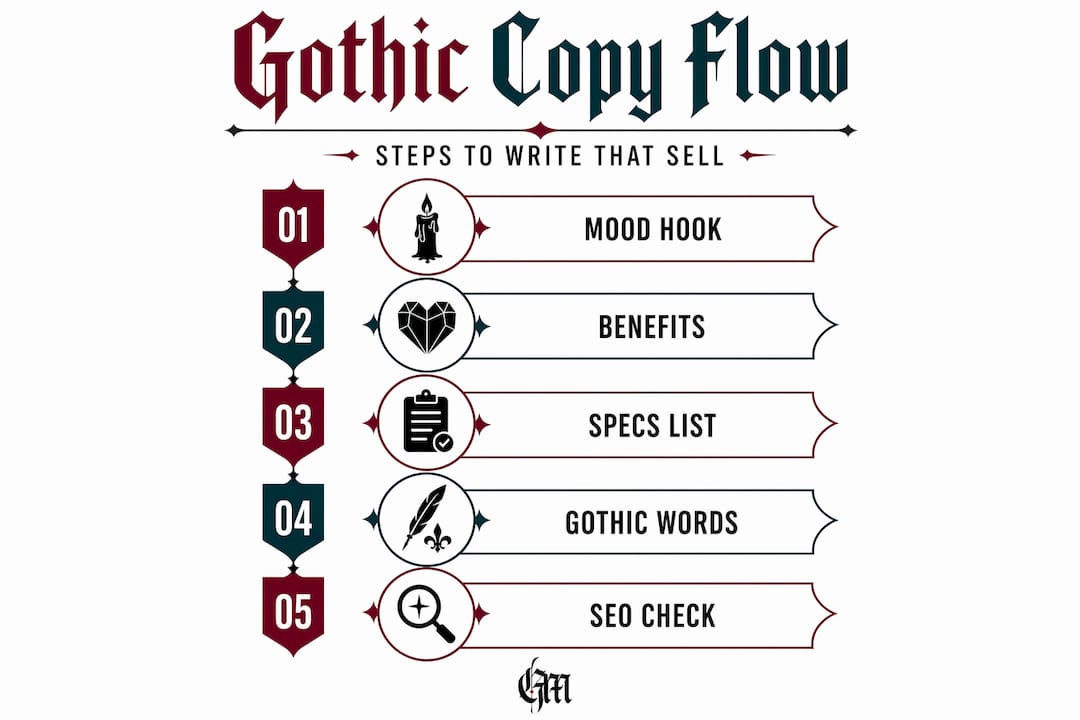
The format that converts consistently looks like this: a gothic hook under ten words, a benefit-driven paragraph of two to three sentences, and a bullet list of key specs. That is the entire blueprint. Optimal descriptions run between 150 and 300 words, which is enough room to set mood and answer questions without losing buyers to scroll fatigue.
Here’s how each layer works:
| Layer | Purpose | Example |
|---|---|---|
| Gothic hook | Set the mood instantly | “Born from shadow. Worn by the defiant.” |
| Benefit paragraph | Connect product to the buyer’s life and identity | Explain what wearing or owning the piece does for them emotionally and practically. |
| Bullet specs | Answer practical questions fast | Material, dimensions, care instructions, color options, sizing. |
Aim for four to six bullet points in your spec list. Fewer and buyers feel like they’re missing information. More and the page looks like a technical manual. The hybrid structure satisfies both the emotional shopper who wants to feel something and the practical one who needs to know the chain length before committing.
Pro Tip: Write your bullet points first. Knowing exactly what the product is made of and how it fits makes it far easier to write the atmospheric hook that matches its real qualities.
Choosing gothic language that does real work
This is the section most gothic creators think they already know, then execute poorly. The issue is not a lack of creative vocabulary. It’s reaching for the same words every other gothic brand uses. “Dark.” “Mystical.” “Ethereal.” These words have been worn smooth by overuse. They register as background noise.
The goal of creative gothic descriptions is specificity. Specific adjectives like “haunting,” “velvety,” “veiled,” and “smoke-stained” do more work than any amount of “beautiful” or “unique” ever will. They paint an actual picture. They give the buyer a sensory experience before the product arrives.
Sensory language is your most powerful tool. Don’t just describe what a piece looks like. Describe:
- Texture. “Brushed with a finish that catches candlelight like tarnished silver.”
- Weight and presence. “Heavy enough to feel like armor. Light enough to forget you’re wearing it.”
- Context and setting. “The kind of ring that looks like it belongs on an altar.”
Beyond adjectives, consider adding a brief origin story or mood-setting context. Gothic storytelling works best when it uses arcs: forbidden knowledge, origin myths, quiet power. Even two sentences of story can shift a listing from “item for sale” to “object with meaning.” Think of it less as fiction and more as framing. Where did the inspiration for this piece come from? What world does it belong to?
“The best gothic product description doesn’t just describe what’s in the box. It tells the buyer who they become when they wear it.”
One more note on typography: if you use gothic blackletter fonts in your product page headings, reserve blackletter for headlines only. Dense gothic script in body text is difficult to scan, and poor readability kills conversions regardless of how beautiful the font looks. Pair it with a clean sans-serif for description text. The aesthetic holds. The readability improves dramatically.
Optimizing descriptions for ecommerce and search
Writing beautifully is not enough if no one finds your listing. Gothic product copywriting tips almost always skip this part, but SEO and atmosphere are not opposites. They coexist when you plan for them.
The Etsy search algorithm scans your entire description for relevant keywords. The smartest move is placing two to three long-tail phrases in your first 100 words. Think phrases like “hand-forged gothic iron candle holder” or “Victorian mourning lace choker” rather than just “gothic jewelry.” These phrases target real search behavior from buyers who already know what they want.
Here is how to build SEO into gothic descriptions without killing the mood:
- Open with your atmospheric hook, then fold a keyword naturally into the second sentence of your benefit paragraph.
- Use the product’s actual materials, process, and style in language buyers would search for.
- Avoid keyword stuffing. Repeating “gothic necklace” six times tanks both your rankings and your reader’s trust.
- Answer unasked buyer questions directly: Does this tarnish? Is the sizing true? What does the packaging look like?
- Format for mobile. Short paragraphs. Bullet points. White space. Most gothic shoppers browse from their phones, and walls of text lose them before they reach the specs.
You can also look at optimizing product pages for deeper ecommerce SEO strategies that apply directly to niche markets like gothic and alternative fashion.
Pro Tip: Read your description aloud before publishing. If a keyword phrase sounds awkward or forced when spoken, rewrite the sentence until it sounds natural. If it flows in conversation, it will feel natural to a reader and rank without penalty.
Common mistakes gothic creators make in product copy
Even experienced creators fall into these traps. Knowing the pattern makes it easy to catch before a listing goes live.
- Writing too abstractly. A description that is pure atmosphere with no specs leaves the buyer with feelings but no information. Feelings do not close sales on their own.
- Using cliché gothic terms. Words like “mystical,” “dark,” and “enchanting” appear in thousands of listings. They signal nothing unique about your product. Replace them with words specific to your actual item.
- Ignoring or overdoing SEO. Skipping keywords entirely means no organic discovery. Cramming in too many means search penalties and writing that reads like a robot composed it.
- Skipping buyer hesitation points. If your product runs small, say it. If it’s handmade and takes two weeks to ship, say it. Clear, benefit-first descriptions that answer unasked questions outperform listings that stay silent on practical details.
- Inconsistent brand voice. If one listing reads like Edgar Allan Poe and the next reads like a hardware store catalog, buyers notice. They lose confidence in your brand even if they can’t articulate why.
Pro Tip: Audit your five best-selling listings and five worst-selling ones. Compare the writing. You will almost always find the pattern: the best sellers have a clearer hook and more specific language, not more poetic language.
My perspective on gothic copy that actually works
I’ve watched creators pour genuine artistry into products and then write descriptions that apologize for them. Short, vague, almost embarrassed to take up space. Here’s what I’ve learned: the gothic buyer is not confused by atmosphere. They are drawn to it. But they will not buy through fog alone.
What actually works, in my experience, is treating the description like a two-act piece. Act one is mood and identity. Act two is clarity and trust. Most creators write a strong act one and abandon act two entirely. The result is a listing that gets saved but never purchased.
The other thing I’ve seen misunderstood is the relationship between SEO and gothic voice. Creators assume keywords will corrupt their aesthetic. They won’t, if you treat them as part of the description’s architecture rather than decoration sprinkled on top. A phrase like “hand-cast resin gothic ring with crescent moon inlay” is both searchable and atmospheric. It works on both levels because it’s specific, not because it’s poetic.
The gothic community rewards authenticity. When a description feels true to the object and true to the maker, buyers feel it. That trust becomes loyalty. And loyalty, in a niche market, is worth more than any single conversion. Understanding your gothic audience deeply is what separates creators who sell once from those who build a following.
— Rey
Explore gothic pieces worth describing
If you want to see gothic product storytelling in action, spend some time with the gothic jewelry collection at Goth.Market. Each piece is the kind of object that demands a real description, not a placeholder.
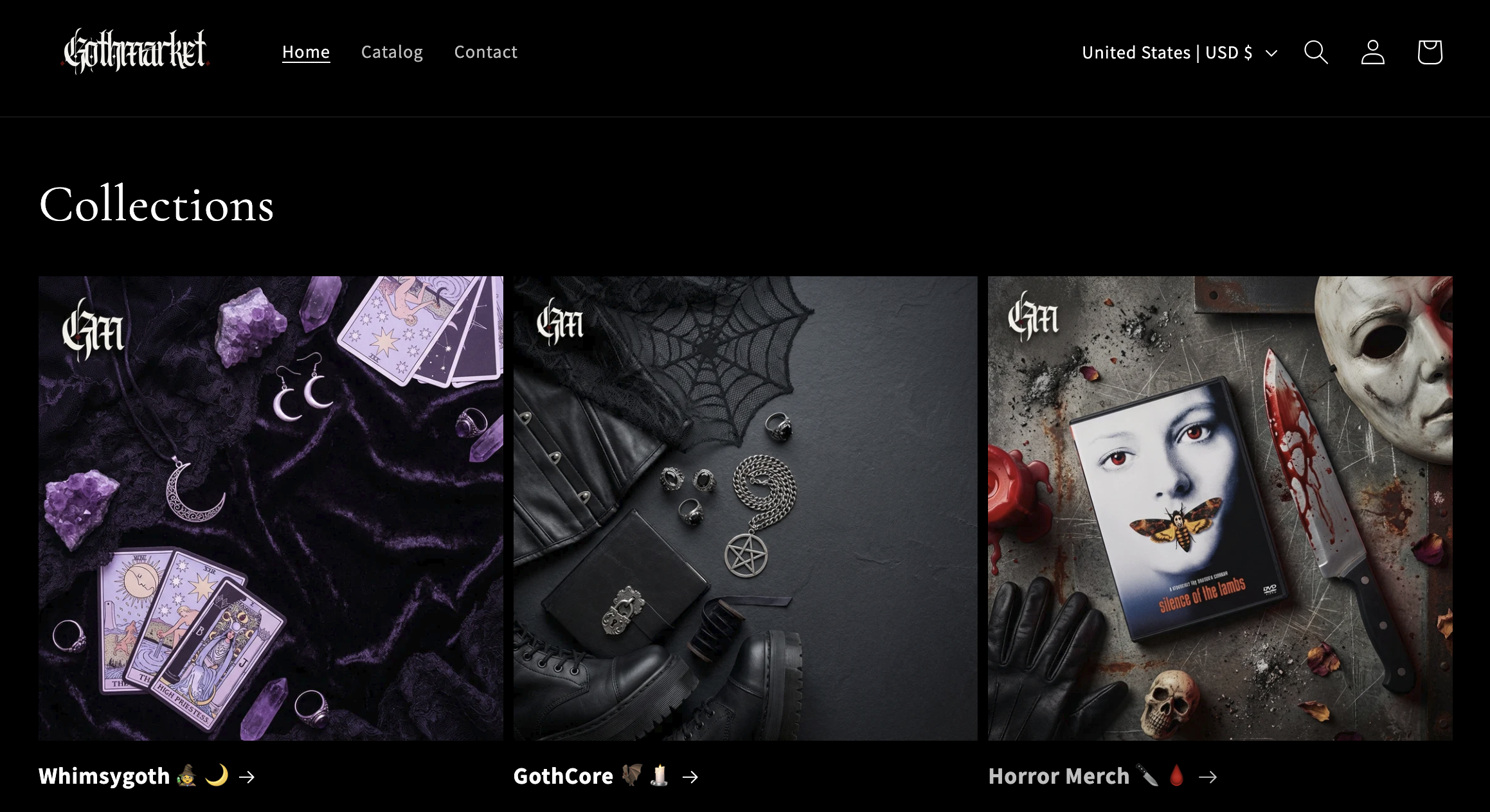
Take the Celestial Chain Choker with Moon Pendant as a study in what deserves evocative copy: the weight, the symbolism, the way it sits against different necklines. Writing a description for a piece like that teaches you more than any template can. You can also browse the Whimsygoth collection for inspiration on how playful gothic aesthetics translate into product storytelling. Goth.Market is built for creators like you. Use it as both your marketplace and your creative reference.
FAQ
What length should a gothic product description be?
150 to 300 words is the proven range for product descriptions that convert. That length gives you space for a hook, a benefit paragraph, and a bullet spec list without losing the reader.
How do I add keywords without ruining the gothic tone?
Place long-tail gothic phrases naturally in your first 100 words, woven into benefit sentences rather than listed awkwardly. Specific descriptive language, like “hand-dyed velvet gothic corset,” reads as both aesthetic and searchable.
Should I use gothic fonts in my product descriptions?
Use blackletter fonts for headlines only, not for body text. Dense gothic script is hard to read at small sizes and hurts your conversion rate regardless of the visual appeal.
Why do benefit-focused descriptions outperform feature lists?
Benefit-focused descriptions convert 20 to 40% better than feature-only listings because they connect the product to the buyer’s identity and lifestyle, not just their shopping list.
How do I keep my brand voice consistent across product listings?
Define three to five tone words that represent your gothic brand, then check every description against them before publishing. If a sentence doesn’t sound like those words, rewrite it until it does.